
Daniel Pearce, Senior Health and Science Editor.
There is a particular drawer in most bathrooms. Three or four straighteners live in it: one from a decade ago, one bought in the Boxing Day sales, one borrowed from a sister and never given back. Each promised something slightly different, salon-smooth hair, all-day hold, less damage than the last one. Most people end up typing the same question into a search bar late at night: which one actually works, and how would I even tell before I have singed my fringe.
The honest answer is that the number on the box, the wattage, the brand name, the claimed temperature, tells you almost nothing on its own. What tells a specialist whether a straightener will treat hair well is a short list of physical details you can check with your own hands in a shop on Oxford Street or while reading reviews on Amazon.co.uk. This guide walks through what those details are, why they matter mechanically, and how to test for them yourself.
- Plate evenness matters more than plate temperature: a straightener that runs hot in patches will damage hair faster than one that runs slightly cooler but consistently.
- Your hair’s diameter, not the dial, sets your real working heat: fine hair rarely needs more than 160°C, and pushing higher does not improve the result.
- A straightener that cannot float slightly on its hinge will crush strands rather than smooth them, regardless of what the plate coating is called.
Why The Plates Matter More Than The Wattage Number
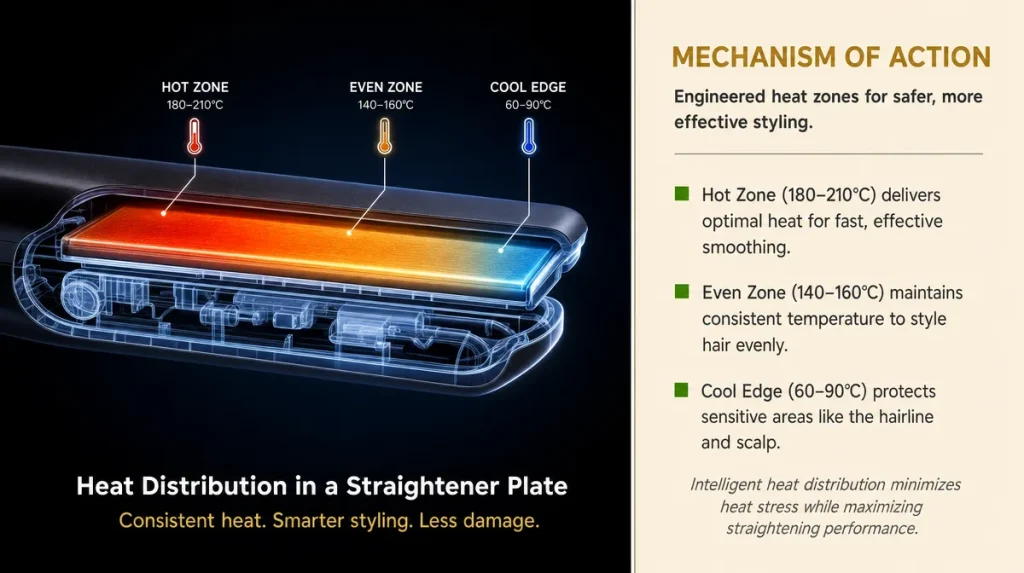
Wattage describes how much power the appliance can draw, not how evenly it applies heat to hair. A specialist looking at a straightener for the first time checks the plate surface for evenness before anything else, because an uneven plate behaves like a frying pan with one hot corner: food nearest the hot spot burns while the rest stays pale. Hair works the same way. A section run through an uneven plate picks up a stripe of overheated cuticle next to a stripe that barely styled at all.
A 2021 study in the International Journal of Trichology measured surface temperature variance across budget and mid-range straighteners and found differences of up to 40°C between the centre and edge of the same plate on several models. That variance, not the peak temperature reached, correlated most closely with visible cuticle damage under microscopy.
The practical test is simple. Heat the straighteners to its working temperature, then hold a strip of tissue paper lightly between the plates for two seconds. If one edge scorches faster than the other, the heat is uneven. Good Housekeeping’s own testing pages for household appliances describe a similar spot-check for irons, and the logic transfers directly.
This single check explains why two straighteners with an identical claimed maximum temperature can produce visibly different results on the same head of hair.
Finding Your Real Working Temperature
Every straightener now carries a temperature dial, usually running from around 130°C to 230°C. Very few buyers know which number is actually right for their hair, so most default to the highest setting on the theory that more heat means more hold. It rarely does.
Hair diameter is the deciding factor. Fine or colour-treated hair generally styles well at 130°C to 160°C. Normal, mid-thickness hair sits comfortably at 160°C to 190°C. Coarse, very curly or resistant hair may need 190°C to 220°C, and rarely benefits from going higher still.
A useful self-test: take one strand from underneath, near the nape, and run it through the straighteners once at the lowest setting. If it smooths on the first pass, that is your number. If it needs two or three passes to lie flat, raise the temperature by 10°C to 15°C and try again, rather than jumping straight to maximum.
The mistake almost everyone makes is treating the dial like a volume control, turning it up when a style is not holding. Poor hold is usually a moisture or product problem, not a heat problem, and more heat on already-dry hair simply adds damage without adding hold. A dermatologist writing in a 2020 issue of the British Journal of Dermatology noted that repeated exposure above 180°C on fine hair correlated with measurable protein loss within weeks, not months.
Matching Plate Width To Your Hair, Not The Advert
Plate width is usually presented as a style choice, narrow for fringes and short hair, wide for long hair, but it is really a mechanical trade-off between speed and control.
Think of it as sweeping a hallway. A wide broom clears more floor per stroke but is clumsy around a doorframe. A narrow broom takes longer over open floor but manages corners cleanly. A wide plate, roughly 3.8 centimetres or more, moves through long, thick sections quickly, which matters because fewer passes mean less cumulative heat exposure on each strand. A narrower plate, closer to 2.5 centimetres, gives far better control near the hairline, the fringe and shorter layers, where a wide plate would catch skin or crimp hair at an angle.
Buyers with long, thick hair who choose a narrow plate often end up doing five or six passes over the same section to finish a head of hair, which multiplies heat exposure unnecessarily. The reverse mistake, a wide plate on short layered hair, tends to produce an obviously flat, uniform look that misses the natural movement of shorter cuts.
The simple test in a shop is to hold the open plates against the length of your longest section. If the plate is noticeably shorter than the section you would normally style in one pass, expect to do more passes than the packaging implies.
The Float Test: Why Moving Plates Protect Your Hair
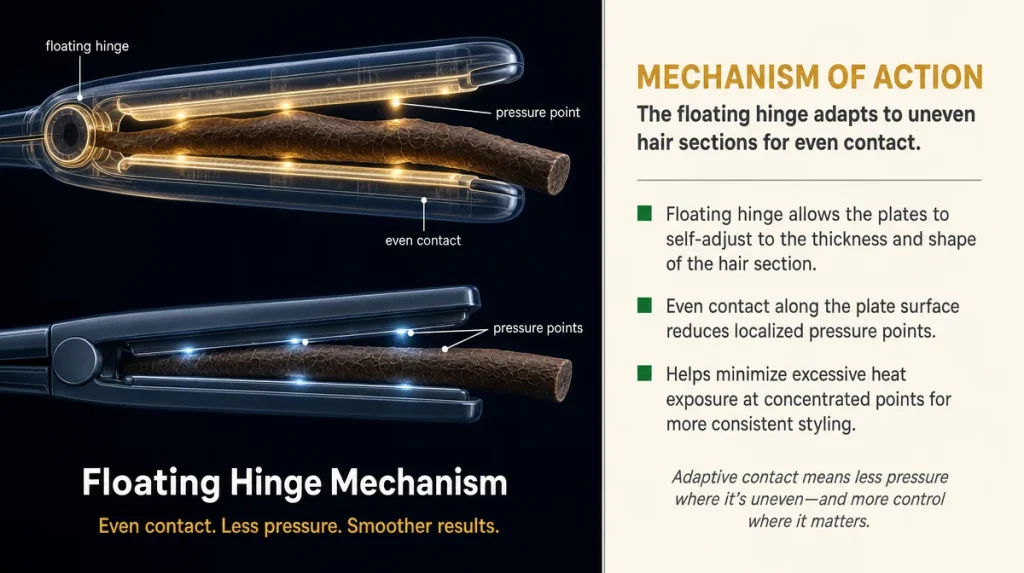
Better straighteners allow the two plates a small amount of give, so they tilt slightly rather than staying rigidly parallel when clamped on a section of varying thickness. This is sometimes called a floating plate, though the manufacturers rarely explain why it matters.
The comparison is a shoe insole. A rigid insole presses evenly only if your foot is a perfect, uniform shape, which no foot is. A slightly flexible insole follows the actual contour of the foot and spreads pressure more evenly. A section of hair is never perfectly uniform in thickness either, thicker near the root, thinner at the ends, so a rigid plate presses hardest where the hair happens to be thickest and barely touches the thinner ends.
To test for float in a shop, close the plates without any hair between them and gently try to rock the top plate side to side and front to back with a fingertip. A small amount of give, a millimetre or two, is what you want. No movement at all usually means a rigid, budget hinge. Excessive wobble, on the other hand, suggests a loose or poorly manufactured clamp that will not apply consistent pressure either.
This is one of the few checks that genuinely cannot be judged from an online listing or a photograph, which is why testing the hinge in person, at Boots or Superdrug, remains worthwhile even for an otherwise well-reviewed model.
What The Dial Tells You, And What The Plate Actually Does
The number on a digital display is a target, not a live reading. Most straighteners use a thermostat that heats the plate, lets it drift slightly above the target, then cuts power until it drifts back down, cycling continuously the way a domestic iron does. This means the true plate temperature oscillates around the displayed figure rather than sitting on it exactly.
The practical consequence is recovery time. A straightener with a strong heating element returns to temperature within a second or two of clamping down on a section, which draws heat away from the plate. A weaker element can take five or six seconds to recover, during which the next section styled receives less heat than the display suggests, so the user compensates by holding it there longer or doing another pass, which is where a lot of avoidable heat exposure comes from.
There is no reliable way to check recovery speed with the eye alone, but a rough proxy exists: straighteners that reach their maximum temperature within roughly fifteen to twenty seconds of switching on, rather than a full minute, generally use a more responsive heating element, and tend to recover faster between sections too. Several appliance testing pages, including those published by consumer bodies such as Which?, report heat-up time as a standard measurement for exactly this reason.
Judging The Hinge, The Clamp And The Click
Pick up any straighteners and open and close them ten times before buying. A well-made hinge closes with one smooth motion and a single, definite click. A poor hinge often needs a small wiggle to align, or closes with a slight grinding resistance, or the two plates do not quite meet flush along their full length.
Misaligned plates are more than a comfort issue. If the plates meet flush only at one end, the section of hair at the other end receives less direct contact and less heat, so styling becomes uneven without the user necessarily realising why. Run a finger gently along the closed plates from the hinge to the tip. Any visible gap of light between the plates at the far end is a sign the hinge is not holding true alignment.
The clamp spring, the mechanism that holds the plates shut under tension while styling, matters just as much. Too weak a spring lets hair slip through without proper contact, so a section needs several passes to smooth. Too strong a spring makes the tool tiring to use for a full head of long hair and can pull at the roots near the scalp.
A reasonable middle ground is a clamp that needs firm but comfortable finger pressure to open, similar to a good pair of kitchen tongs rather than a bulldog clip. If it snaps open with barely any pressure, or requires real effort, that spring tension is likely to cause problems in regular use.
Where Budget Straighteners Cut Corners
Cheaper straighteners rarely cut corners on the plate coating itself, since ceramic or ceramic-coated plates are inexpensive to produce at any price point. The corners tend to be cut elsewhere, in places a buyer does not think to check.
The cord and its swivel joint are common weak points. A cheap swivel stiffens within months, which forces the user to twist their wrist unnaturally while styling, and eventually the joint frays internally, a real safety consideration around a device that reaches over 150°C. Auto-shutoff, which switches the appliance off after a period of inactivity, is another feature often dropped or set to an unhelpfully long delay on budget models, which matters for anyone who has ever left the house wondering if they turned it off.
Insulation of the heatproof tip, the small guard at the end of the plates where fingers naturally rest while sectioning hair, is frequently thinner on cheaper tools, leading to more accidental finger contact burns than the plate temperature alone would suggest.
The Good Housekeeping Institute’s published testing guidance for household electricals highlights auto-shutoff and cord durability as standard checks for exactly this reason, alongside heat performance. None of these details show up in a product photograph, so they are worth asking about directly, or checking in the small print of a listing, before assuming a lower price only means a plainer design.
Reading Your Results Without Kidding Yourself
It helps to know what a straightener can realistically do before judging whether one has worked. A single well-executed pass on correctly prepared, dry hair should leave a visibly smoother cuticle and a flatter lie, typically holding through several hours of normal indoor conditions. Humidity is the real test. British weather being what it is, hold in damp or drizzly conditions is a fairer measure of a straightener’s performance than hold in a warm, dry bathroom straight after use.
A sensible way to judge a straightener honestly is to style the same section of hair, on the same day, at your identified correct temperature, and count the passes needed to achieve a smooth result. One or two passes is a good outcome. Needing four or five passes on the same section suggests either the temperature is wrong for your hair type or the plate has an evenness problem worth revisiting.
Results also depend on hair condition, not just the tool. Very porous, previously bleached hair may never hold a style as long as untreated hair, no matter how good the straightener, and no appliance can substitute for the moisture a damaged strand is missing. A stylist’s rough guide, echoed in several trade publications the British Beauty Council has referenced in its reports on heat styling, is that noticeably reduced hold over several consecutive uses is a sign to give hair a break, not to increase the heat.
Marketing Words Worth Ignoring
A handful of terms appear on nearly every box and mean far less than they suggest. Ionic technology, often described as reducing frizz by emitting negative ions, has limited independent evidence behind it. A 2019 review in the Journal of Cosmetic Science found the claimed frizz-reduction effect measurable in laboratory conditions but small enough in practice that testers could rarely detect a difference blind.
Infrared heating, marketed as gentler because it heats hair from within rather than only the surface, is real physics, but the practical difference for most home users styling already-dry hair is modest at best, according to the same review.
Tourmaline and other gemstone-derived coatings are usually a variation on ceramic coating with a more evocative name attached. The coating itself matters far less than how evenly it was applied, which returns to the plate evenness check described earlier.
“Salon-grade” and “professional” carry no regulated meaning in the UK and can be printed on any product regardless of specification. None of this means these features are worthless, only that they are not a substitute for checking plate evenness, hinge quality and a realistic working temperature, which remain the details that actually predict how a straightener will treat your hair over months of ordinary use, whether bought on offer in the Boxing Day sales or at full price from a high-street chemist counter.
Key Takeaways
A straightener is worth judging on mechanical detail, not marketing language. Even heat across the plate predicts damage more reliably than peak temperature. Your own hair’s diameter, tested with a single strand, sets the correct working heat far better than the highest number on the dial. A hinge with a small amount of float, checked by hand before buying, protects uneven sections of hair that a rigid plate would press unevenly. Recovery speed between sections, cord durability and auto-shutoff sit quietly behind the headline features and matter more than most buyers expect.
A Quick Checklist Before You Buy
- Hold the closed plates up to a light and check for any visible gap along their length.
- Gently rock the closed top plate with a fingertip: a small amount of give is good, none or too much is not.
- Test one strand of your own hair at the lowest setting before assuming you need the highest.
- Check the heat-up time: fifteen to twenty seconds to maximum suggests a more responsive element than a full minute.
- Look for auto-shutoff and a well-insulated heatproof tip, not just the plate coating name.
- Judge results by passes needed on damp-weather hair, not by a single dry, indoor styling session.
This guide offers general information and does not replace advice from a qualified stylist or dermatologist.
Individual results vary depending on hair type, condition and styling habits.