
Emma Holloway, Beauty Editor.
There is a particular moment most of us know well: fringe flat against the forehead, roots dark with a day and a half of oil, and a can of dry shampoo standing on the shelf that somehow never quite finishes the job it promises. You spray, you wait a beat, you brush, and the result sits somewhere between ‘fine’ and ‘still visibly unwashed’. The instinct is to blame the product and go looking for a stronger one on offer at Boots or Superdrug. Often the can is not the problem. The technique is.
A 2021 survey cited by the British Beauty Council found that most people who use dry shampoo apply it in one way: directly to the roots, immediately before leaving the house, then brushed straight through. That single habit, more than the formula inside the can, explains a good deal of patchy, powdery, underwhelming results. Get the timing and the technique right and the same bottle you already own will work harder for you, with less product and less mess.
This guide is not about which dry shampoo to buy. It is about what to do differently with the one already sitting in your bathroom cabinet.
- Apply it the night before, not the morning of: dry shampoo needs time to absorb oil, not just mask it, and a few hours of contact works far better than a rushed thirty seconds before the door.
- Section your hair like a hairdresser would: spraying blindly at a flat head of hair wastes most of the product on hair that was never oily in the first place.
- Brush in stages, not all at once: a single hard brush-through straight after spraying is the single biggest cause of visible white residue.
Why Dry Shampoo Needs Time, Not Speed

Dry shampoo is often used the way people use a fabric freshener: a quick spritz, seconds before walking out the door, expecting an instant transformation. That is not how the chemistry works.
Most formulas rely on starches or clays, rice starch, tapioca starch, kaolin clay, to absorb sebum from the scalp and hair shaft. Think of them like the silica sachet in a new pair of trainers: it needs time sitting next to the moisture to draw it in. Sprayed and brushed out within a minute, that starch has barely begun to absorb anything. It sits on the surface, which is exactly why it can look chalky rather than clean.
A 2019 paper in the International Journal of Trichology measured sebum absorption rates on hair swatches treated with starch-based powders and found meaningfully higher oil uptake after 15 to 20 minutes of dwell time compared with brushing out immediately. The practical upshot: apply dry shampoo the night before an early morning, or at minimum half an hour before you need to leave, rather than as a last-minute rescue.
Self-test: next time you reach for the can, set a kitchen timer for ten minutes after spraying before you touch a brush to your hair. Most people notice a visibly better finish than their usual rushed routine, simply from that pause.
Finding Your Real Oil Map Before You Spray
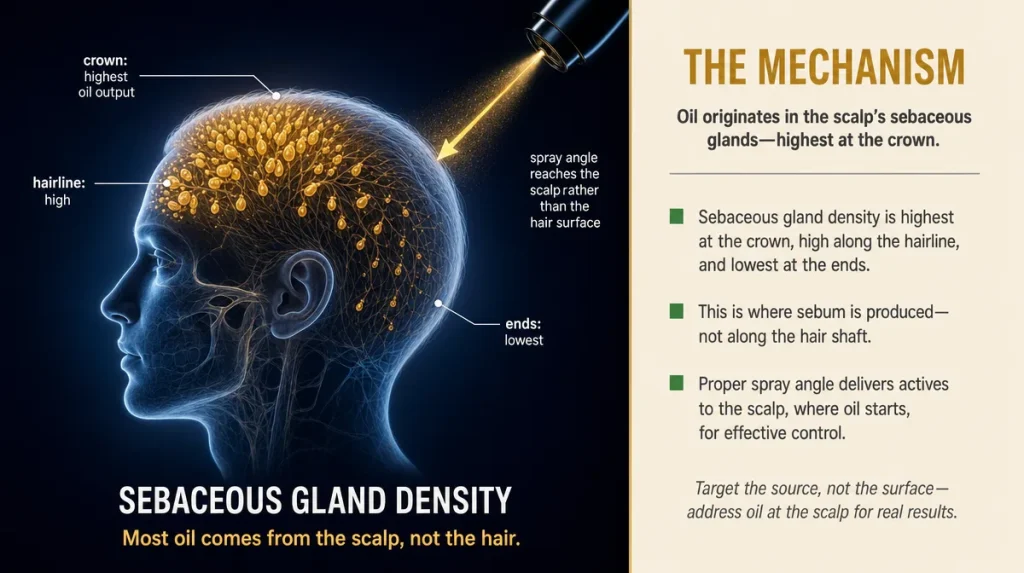
Scalps are not uniformly oily. Sebaceous glands cluster more densely at the crown and around the hairline, which is why those areas look greasy first while ends and the underneath layers stay drier for days longer.
Spraying dry shampoo evenly across the whole head, the way most people do standing in front of a mirror, wastes product on hair that was never oily and under-treats the parts that actually need it.
The fix is the same one a colourist uses before applying toner: work in sections. Part the hair into four or five panels using a comb or your fingers, lift each section, and spray directly onto the scalp at the roots rather than over the top of the hair. Hold the can around 15 centimetres away, in short bursts rather than one long spray, concentrating on the crown, the parting and the hairline, where oil actually accumulates first.
Mistake to avoid: spraying downward onto the surface of already-styled hair. Almost none of the product reaches the scalp that way, and you end up reapplying more than you need, which is usually what causes visible build-up over a few days.
The Two-stage Brush-through That Prevents White Cast
White residue is the single most common complaint about dry shampoo, and Which? testing of household haircare products has repeatedly flagged visible cast on darker hair shades as a recurring weakness across many formulas on the market, not just cheaper ones.
The cause is usually less about the product’s tint and more about how it is worked in. Brushing immediately, once, in one direction, simply redistributes the powder across the surface rather than breaking it down into the hair.
A better method used by session hairstylists: brush in two stages. First, use your fingertips to massage the product into the roots for about thirty seconds, the way you would work in a leave-in treatment, which begins breaking up the powder and helps it blend with natural oils rather than sit on top of them. Only then brush through, and do it in sections rather than one sweep from root to tip, starting underneath and working upward.
For darker or richer hair colours, a small amount of cocoa- or rice-tinted powder rather than a plain white-cast formula makes a visible difference, though the two-stage brushing method matters more than the tint itself.
Self-test: after brushing, run a clean finger along the parting. If powder transfers visibly onto your finger, it has not been worked in enough and needs a further, gentler brush pass.
Judging Results Honestly: What Clean Actually Looks Like
It helps to be realistic about what dry shampoo can and cannot do. It absorbs surface oil and lifts limp roots. It does not clean the scalp the way water and a proper wash do, and dermatologists writing in general public guidance, including material published by the Good Housekeeping Institute on haircare basics, are consistent that dry shampoo is a styling tool for extending a blow-dry, not a substitute for washing.
A realistic result, done well, gives you visibly lifted roots and reduced shine for one, sometimes two, extra days beyond when you would normally need to wash. If you are expecting it to erase a scalp that genuinely needs washing, the result will always disappoint, regardless of technique.
To judge whether your technique is working, look at three things the next morning: does the parting still look separated rather than stuck together, is there any visible white cast in good daylight near a window, and does the scalp feel powdery-dry to the touch rather than tacky. If all three are fine, your application is working. If the scalp still feels tacky by evening, you likely need to increase dwell time rather than the amount of product.
Where Marketing Claims Outrun The Formula
Packaging language on dry shampoo cans has grown increasingly ambitious: detox, purifying, volumising, scalp care. Some of this reflects genuine formula differences. Much of it does not change how the product performs at the roots.
The core mechanism, starch or clay absorbing oil, is broadly similar across most mainstream formulas sold at Boots, Superdrug and in Marks and Spencer beauty halls. Added extras such as charcoal or added fragrance oils can make a real difference to scent and light exfoliation over time, but they do not meaningfully change the oil-absorbing job the product is bought to do.
The genuinely useful thing to check on a label is the propellant type, aerosol versus a powder-based pump, because that affects how finely and evenly the product disperses, which in turn affects how much visible cast you get and how much product you need per use. Fine, well-milled powder formulas generally need less product and produce less visible residue than coarser, older-style aerosol sprays, independent of what the front label claims about detoxing or volume.
It is worth reading the ingredient list the way you would read a food label: the first two or three ingredients tell you what is actually doing the work, everything after tends to be about scent and feel.
Building It Into A Routine That Stretches A Wash
Dry shampoo works best as part of a small sequence rather than a single rescue spray. Damp winters and central heating in most British homes actually dry hair strands out even as scalps stay oily, which is a slightly counterintuitive combination worth knowing: your ends may need more moisture in January while your roots still need oil control.
A workable weekly rhythm: wash and style normally, then on day two apply dry shampoo the night before at the roots only, following the sectioning method above. On day three, if needed, a very light top-up focused only on the crown and parting, rather than a full reapplication across the whole head, tends to avoid the build-up that makes hair look dull and heavy by day four.
If you find yourself needing to reapply daily just to get through, that is usually a sign the scalp needs an actual wash rather than more product stacked on top of what is already there. Stacking layers of starch without washing between applications is the most common reason people report dry shampoo eventually stopping working, when in fact it is simply sitting on several days of unabsorbed residue.
Key Takeaways
Technique changes the result far more than switching products does. Apply the night before where possible, work in sections rather than spraying blindly, massage before brushing, and judge success by touch and daylight rather than by how the can promises to perform.
A Quick Checklist Before You Spray
- Apply at least 30 minutes before you need to leave, ideally the night before
- Section the hair and spray directly at the roots, not over the surface
- Hold the can around 15 centimetres from the scalp, in short bursts
- Massage in with fingertips for around 30 seconds before brushing
- Brush in sections, starting underneath, rather than one full sweep
- Check the parting in daylight for cast before leaving the house
- If reapplying daily just to cope, plan an actual wash instead
This article is for general information only and is not a substitute for professional advice.
Individual results vary depending on hair type, scalp condition and product formula.