
Priya Nair, Staff Writer.
Stand in front of the bathroom mirror at half past seven and the evidence is right there on the shelf: three or four foundations, two barely touched, one bought after a video promised it would erase every mark by lunchtime. Most people who reach for full-coverage foundation are not vain. They are tired of buying the wrong bottle.
Full coverage does not mean the thickest formula on the shelf. It means a higher concentration of pigment particles suspended in less oil or water, so more light gets blocked with the same touch. That single fact explains why some full-coverage formulas feel lighter than a supposedly ‘natural’ one, and why a sensible buying decision starts with the pigment load rather than the marketing word on the front of the bottle.
This guide works through what actually separates a foundation that holds up at four in the afternoon from one that slides into every fine line by lunch: how to read your own undertone honestly, how texture interacts with your particular skin, and which claims on the box are worth trusting.
- Coverage comes from pigment concentration, not thick texture: a lightweight formula can out-cover a heavy one if it carries more pigment per gram.
- Undertone is judged in daylight, never under shop lighting: fluorescent strip lights flatten warm, cool and neutral tones in a way a window never does.
- Technique changes the finish more than the product does: the same bottle can look natural buffed in and cakey stippled on, depending on tool and motion.
What ‘Full Coverage’ Actually Means
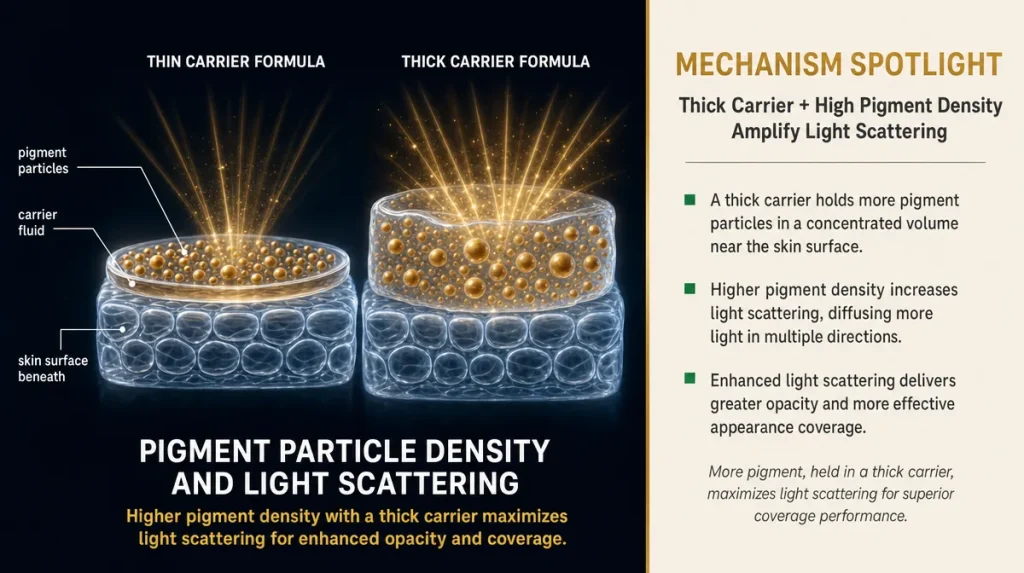
Coverage is often talked about as if it were a texture: thick, heavy, cakey. In reality it is a matter of concentration. Foundation pigments, usually iron oxides and titanium dioxide, sit suspended in a base of water, oil, silicone or some blend of the three. The more pigment particles per gram of product, the more light they scatter and absorb, and the more skin discolouration they hide.
Think of it the way a barista thinks about coffee. A double espresso is not thicker than a filter coffee poured from the same jug; it simply carries more ground coffee dissolved in less water. Full-coverage foundation works the same way. Some of the lightest-feeling formulas on the shelf are full coverage because the manufacturer has packed in pigment and kept the carrier thin, while a ‘dewy, natural’ foundation can feel heavier on the skin while covering considerably less.
This matters because a lot of buying mistakes start with judging a bottle by how it feels on the back of the hand. A gel-like, almost watery foundation might be doing more concealing work than a thick, opaque-looking cream. The only reliable way to know is to check the ingredients list: pigments listed near the top, alongside a comparatively low water or oil content, generally signal a more concentrated, higher-coverage formula.
The self-test: dab a small amount on the inside of your wrist and rub it in for ten seconds. If your natural skin tone all but disappears, you are holding a full-coverage formula, regardless of what the front label calls it.
Finding Your Undertone In Daylight

Shade-matching goes wrong for one recurring reason: it is usually done under the wrong light. The fluorescent strip lighting above a chemist’s cosmetics aisle flattens warm and cool tones alike, which is why a foundation that looked perfect in the shop can look grey or orange the moment you step outside.
Undertone, not depth, is what most people get wrong. Depth is how light or dark your skin is; undertone is whether it leans warm, cool or neutral. Jewellery preference is a popular but unreliable shortcut. Wrist veins are only marginally better, since lighting and circulation both distort them.
The more dependable self-test takes two minutes. Apply three swatches along the jaw, not the wrist or hand, in a shade you think is close, one shade warmer and one cooler. Walk to a window or step outside for a moment. The correct shade should seem to vanish into the jawline rather than sitting as a distinct stripe.
If you are shopping in person, most chemists and department beauty halls, including the counters at Marks & Spencer’s beauty halls, keep testers near a window or under daylight-corrected bulbs for exactly this reason. It is worth asking a member of staff to point you to it rather than matching under the till lighting.
Matching Formula To Your Skin’s Actual Behaviour
A full-coverage foundation is only as good as its fit with your skin’s oil and moisture levels, and this is where most drawers end up with three half-used bottles.
Oily skin tends to break down silicone-heavy, matte-finish formulas faster, as sebum lifts the product and pushes pigment into pores by mid-afternoon. Dry skin does the opposite: a full-coverage matte formula will grip onto flaky patches and emphasise them rather than hiding them.
The household analogy is a raincoat. A silicone-based matte foundation behaves like a waterproof jacket: it sits on top and repels moisture, including your skin’s own oil, which is fine until the skin underneath needs to breathe or hydrate. A water- or serum-based full-coverage formula behaves more like a breathable soft-shell: it moves with the skin and lets some moisture through, which usually suits drier or more mature skin better.
The common mistake is buying on trend rather than on skin type. A formula praised online for long wear is often a heavily silicone-based matte finish, well suited to oily T-zones and unforgiving on dry cheeks. This is especially relevant in a British winter: central heating and damp outdoor air combine to dry out skin more than the cold itself does, so a foundation that worked well in July can feel tight and flaky by November without any change in your skincare.
The fix is rarely a different foundation altogether. Often it is a different primer, or a few drops of facial oil mixed in on drier days, adjusting the same bottle to the season rather than replacing it.
The Application Method That Changes Everything
Two people can use the identical bottle and get entirely different results, and the difference is almost always technique rather than product.
Stippling, the bouncing motion done with a domed sponge, presses foundation into the skin in small dots, building coverage gradually and leaving a slightly textured, natural finish. Buffing, done with a dense circular brush in small overlapping motions, spreads foundation into a thinner, more even film and tends to look more polished. Fingers warm the product and can melt it into skin quickly, which suits thinner formulas but can drag a very full-coverage one into visible lines.
The most common mistake is applying too much product at once and then trying to blend it away. Full-coverage foundation is designed to be built in thin layers, not applied thickly in one pass. A pea-sized amount, worked from the centre of the face outward, covers most people; a second thin layer only where redness or marks persist does more work than doubling the amount everywhere.
The second common mistake is skipping the neck and jaw. Full-coverage pigment shows a hard edge more readily than a lighter formula, so an unblended jawline reads as a mask rather than skin. Blending a small amount downward, even without covering the neck fully, softens that edge.
Self-test while reading: run a finger from cheek to jaw. If you feel a ridge of product rather than a gradual fade, the foundation has not been blended far enough down, regardless of how good the shade match is.
Setting Without Looking Cakey
Full-coverage foundation is more prone to looking cakey than sheer formulas, simply because there is more product sitting on the surface for powder to cling to.
The mechanism is straightforward: loose or pressed powder absorbs oil and locks foundation in place, but powder particles reflect light differently from skin, which is what creates that flat, dry appearance around the eyes and along smile lines by the afternoon.
The mistake almost everyone makes is applying powder evenly across the whole face. Skin does not produce oil evenly. The T-zone usually needs setting powder; the under-eye area and outer cheeks, which move and crease more, generally need little or none.
A useful self-test: press a clean tissue lightly against the centre of your forehead about four hours after application. If it comes away with visible oil, that area needed more setting; if the tissue is dry but your under-eye looks flat and lined, that area was over-powdered.
Setting spray, used sparingly from about thirty centimetres away, can soften the flatness of powder without undoing the coverage underneath, but it will not rescue a foundation applied too thickly in the first place. The order of operations, thin layers of foundation then powder only where needed, matters more than any single product used at any stage.
Judging Whether It’s Actually Working
The only fair test of a full-coverage foundation is wearing it through an ordinary day, not admiring it in the mirror five minutes after application.
Give a new foundation at least two full wears before deciding. The first application can be flattered by fresh primer and undivided attention; the real test is how it looks after several hours of talking, eating and touching your face without thinking about it.
Before that, though, comes a safety step that is easy to skip when a colour looks promising. Which?, the consumer organisation, has published general guidance encouraging shoppers to patch-test any new cosmetic on the inner forearm and wait 48 hours before applying it to the face, particularly for anyone with a history of skin reactions. This applies as much to a foundation as to any other leave-on product, since pigments and preservatives can trigger irritation that only shows up a day or two later.
When judging the wear itself, look at three specific points rather than the whole face at once: the sides of the nose, where oil tends to break formula down first; the under-eye, where fine lines can trap product; and the jawline, where a poor colour match becomes obvious in changing light. If all three still look even and undisturbed by mid-afternoon, the formula genuinely suits your skin. If only one area has broken down, the fix is usually a targeted touch-up for that zone, not a wholesale change of foundation.
Marketing Words Worth Ignoring, And The Ones That Matter
The front of a foundation bottle is written by a marketing team, not a chemist, and it pays to know which phrases are meaningful and which are decoration.
‘Buildable coverage’ is genuinely useful information: it tells you the formula is designed to be layered thinly, which most full-coverage foundations are regardless of what else the label says. ‘Long-wear’ or extended-hour wear claims are harder to verify and rarely tested on real skin under normal conditions; treat them as a rough hint rather than a guarantee.
SPF listed on a foundation is real but usually insufficient on its own. Most people apply far less foundation than the thick, even layer used in laboratory SPF testing, so the printed number overstates the protection actually achieved on an average face. It is sensible protection layered on top of a dedicated sunscreen, not a replacement for one, particularly given how much shorter and less reliable a British summer is compared with the length of the SPF conversation online.
Beauty desks that test claims for a living, including at titles such as Cosmopolitan UK and Stylist, have repeatedly noted that award badges and ‘holy grail’ labels tend to reflect editor preference and reader polls rather than independent laboratory scoring. That distinction is worth knowing before treating any badge as proof a formula suits your particular skin.
The phrase worth trusting most, oddly, is the plainest one: ‘medium to full’, because it tells you the formula can be worn thin or built up, which is the flexibility most people actually need day to day.
When To Skip Full Coverage Altogether
Full coverage is a tool for specific problems: pigmentation, active breakouts, scarring, uneven redness. It is not the default setting for every day, and using it as one usually creates more work than it saves.
On a day without much to conceal, a full-coverage formula spread over the whole face can look like a mask rather than skin, and it takes longer to remove properly at night, which matters for anyone prone to congestion. A tinted moisturiser or a medium-coverage foundation, applied only where needed with a full-coverage concealer for specific marks, often looks more natural and takes less time.
The practical rule: reserve full coverage for the areas that need it, and let lighter, more breathable product cover the rest of the face. This mixed approach, a concealer only over blemishes or redness and a lighter base everywhere else, tends to outperform full coverage applied uniformly, both in how natural it looks and in how it wears through the day.
It is also worth reconsidering full coverage seasonally rather than buying one bottle for the whole year. Skin often needs less concealing in summer, when colour is more even, and more through a damp, centrally heated winter, when dullness and dryness are more visible. Treating foundation as a small wardrobe with two or three options, rather than one bottle expected to do everything, tends to solve more problems than any single formula could.
Key Takeaways
- Coverage is about pigment concentration, not texture: a light-feeling formula can cover more than a heavy one.
- Match undertone in daylight, ideally near a window, never under a shop’s overhead strip lighting.
- Choose formula by how your skin actually behaves (oily, dry, combination), not by what is trending.
- Build coverage in thin layers rather than applying a thick single pass, and blend down to the jaw.
- Set only where skin is genuinely oily; leave the under-eye and outer cheeks alone or barely touched.
- Patch-test any new formula on the inner forearm and wait 48 hours before it goes on your face.
- Save full coverage for what actually needs concealing, and let a lighter product handle the rest.
A Two-minute Checklist Before You Buy
- Check the ingredients list for pigment position, not the word on the front of the bottle.
- Swatch three shades along the jaw and check them in daylight, not shop lighting.
- Decide oily, dry or combination first, then look for the matching base (silicone-led versus water or serum-led).
- Ask whether you need full coverage everywhere, or just over specific marks.
- Plan to trial it for at least two full wears before judging the result.
This guide is general information and is not a substitute for personalised advice from a dermatologist or professional make-up artist.
Individual results vary depending on skin type, formula and application technique.