
Emma Holloway, Beauty Editor.
You have bought the lipstick that promised sixteen hours before. It survived a coffee, most of the school run, and then vanished somewhere between lunch and the four o’clock meeting, leaving a faint stain and a ring around the outer edge of your mouth. The tube is probably still in your bag, half used, because it felt wrong to throw away something you paid for.
The truth is that “long-wear” on a label is a marketing category, not a guarantee, and the products inside it vary enormously in how they are built and how they behave on real mouths that talk, eat, and drink tea. One genuinely useful fact before anything else: most fading you see by mid-afternoon is not the pigment disappearing, it is the top layer of colour transferring onto cups, cloth, and skin while a base layer stays put, which is why lips often look patchy rather than simply pale. Once you understand that split, you can judge a formula properly instead of guessing from the packaging.
This piece will not tell you which lipstick to buy. It will tell you how to read a formula, test it on your own skin before you commit, and separate the claims that mean something from the ones that exist purely to sell.
- Fading is usually transfer, not disappearance: the pigment layer lifts off in patches long before the colour is actually gone, which is why lips look uneven rather than bare.
- The back-of-hand test predicts real-world wear: a two-minute rub-and-time check at the counter tells you more than any claim on the box.
- Application technique changes wear time more than price does: how you prep and set the lips can add hours regardless of what the tube cost.
Finding Your Undertone In Daylight
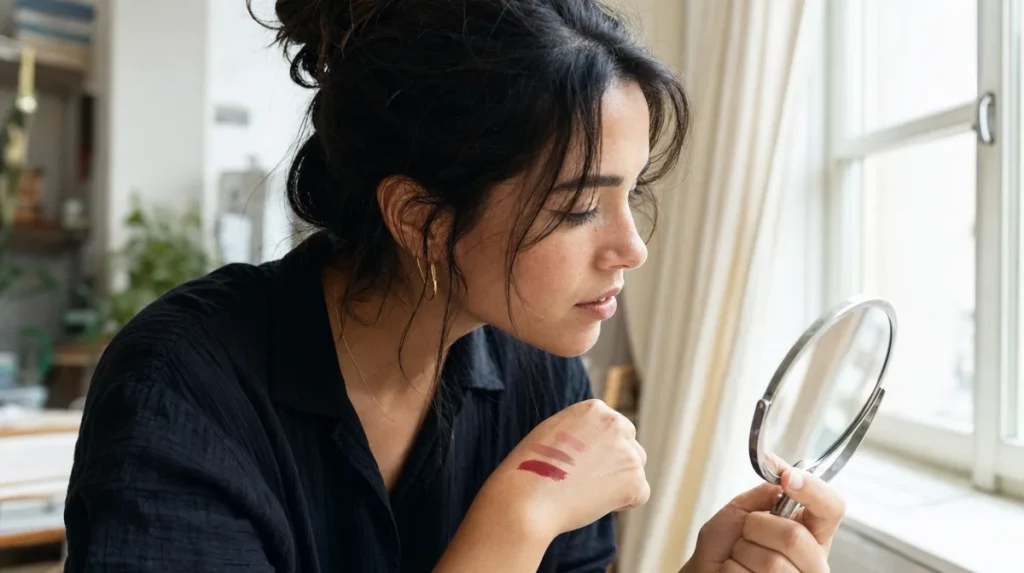
Shop lighting lies. The overhead spots in most chemists and beauty halls throw a yellow or blue cast that makes almost every red look slightly wrong, which is why so many lipsticks bought under fluorescent light get returned, or worse, just abandoned in a drawer.
The simplest fix is to test colour where you will actually wear it: near a window, in daylight, with a small hand mirror. Swatch on the lower lip, not the back of the hand, because lip skin has a different base tone and blood flow than the hand does. Wait ten seconds before judging the shade, since some pigments oxidise slightly on contact with lip skin and shift warmer or cooler within moments.
If you are unsure whether you lean warm or cool, look at the veins on the inside of your wrist in daylight. Greenish veins usually mean a warmer undertone; blue or purple veins usually mean cooler. It is not an exact science, and dermatologists note it is only ever a starting point, but it narrows the field faster than reading marketing copy about “universally flattering” shades, a phrase that means very little once you are standing in daylight.
A quick, useful habit: photograph the swatch on your phone in natural light before you decide. Screens correct colour more honestly than shop mirrors, and you can compare several swatches side by side later, at home, without the pressure of a counter assistant waiting.
What “Long-wear” Actually Means Underneath The Marketing
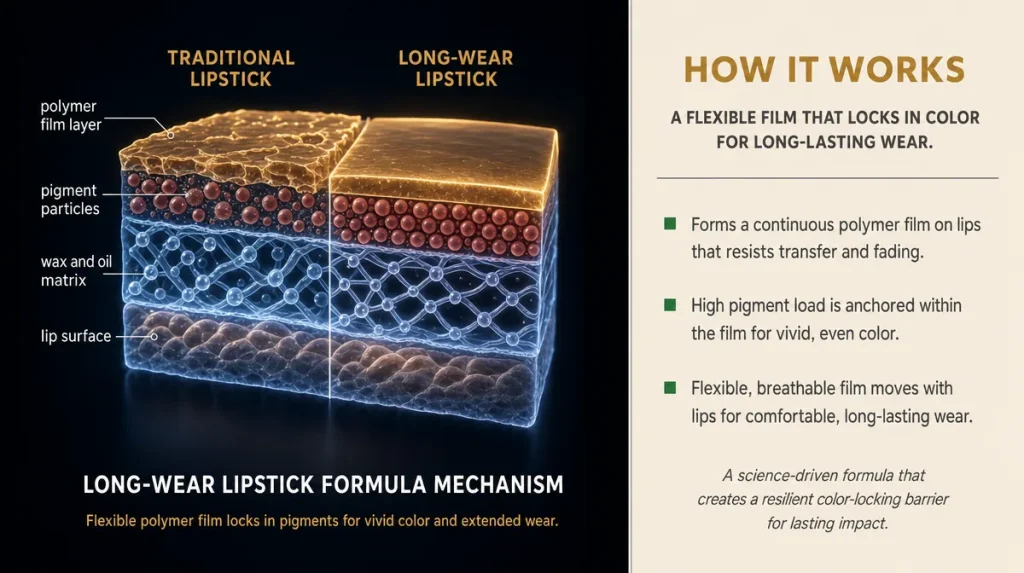
Most long-wear lipsticks work in one of two ways, and knowing the difference explains almost everything about how they feel and fade.
The first type relies on film-forming polymers, ingredients that dry down into a thin, flexible layer of colour that grips the lip surface, rather like a coat of varnish sitting on wood rather than soaking into it. These formulas tend to be genuinely transfer-resistant because the colour is locked under a dry film, but that same film can feel tight or flaky, particularly once central heating has already dried the lips out, which British winters do reliably from October onwards.
The second type leans on high pigment loads suspended in waxes and oils, closer to a traditional bullet lipstick. These feel more comfortable and glide on more easily, but the colour sits more loosely on the surface, so it transfers more readily onto cups and collars.
A useful household analogy: the polymer type behaves like varnish, the wax type behaves like paint. Varnish resists water and rubbing far better, but it can crack if the surface underneath is not properly prepared. Paint goes on smoothly and forgives an uneven surface, but it rubs off more easily onto anything it touches.
Neither approach is objectively better. A dermatologist writing in a 2021 review in the International Journal of Cosmetic Science noted that transfer resistance and comfort tend to sit at opposite ends of a formulation trade-off, and that manufacturers choose where to sit on that scale deliberately, depending on the promise on the box.
The Two-minute Counter Test That Tells You More Than The Label
Before buying, do this on the back of your hand, not your lips, since hand skin is easier to observe under counter lighting and will not affect anything you eat or drink.
Apply a stripe about two centimetres long. Start a timer. After sixty seconds, press a clean tissue against it once, firmly, the way a napkin would touch your mouth after a sip of tea. Look at how much colour transfers.
At the two-minute mark, rub the swatch gently with one fingertip, five times, as if you were unconsciously touching your lips the way most people do without noticing. A formula that survives this with only slight fading is genuinely transfer-resistant. One that smears immediately is a wax-and-oil type, comfortable but not built for a full day without touch-ups.
This test will not tell you how a lipstick feels on actual lip skin, which is thinner and more mobile than the back of the hand, but it is a fair proxy for pigment adhesion, and it takes less time than reading the box. Good Housekeeping’s consumer testing has long used comparable rub tests as a basic screen before longer wear trials, and there is no reason a shopper cannot borrow the same logic at a counter in Boots or Superdrug before committing to a full-price tube.
Reading An Ingredients List Without A Chemistry Degree
You do not need to recognise every word on an INCI list to judge it usefully. Three groups of ingredients matter more than the rest.
Look near the top of the list for silicones, commonly listed as dimethicone or trimethicone. These create the smooth, non-drying glide that makes a matte formula bearable, and their presence high in the list usually signals a more comfortable wear.
Further down, look for film-forming agents such as polymethylsilsesquioxane or VP/VA copolymer. These are the true long-wear engine described earlier, and their absence in a product marketed as long-wear is a signal the claim rests mostly on pigment concentration rather than genuine hold.
Finally, check for emollients such as castor oil, jojoba oil or shea butter, usually appearing mid-list. Their position matters: near the top, they suggest a comfort-first formula that will not last as long; near the bottom, in small amounts, they suggest a formula using them only to soften the edges of a genuinely long-wearing base.
None of this requires memorising chemistry. It requires reading the order of the list, since ingredients are listed by concentration under UK cosmetic labelling rules, and position tells you more than the marketing panel on the front of the box ever will.
Where Cheap Formulas Actually Cut Corners
Cost differences in lipstick formulation are real, though rarely where shoppers assume.
The most common shortcut is in pigment grinding. Finer, more evenly milled pigment particles disperse more smoothly and produce a truer, less patchy colour, but fine milling is a slower, more expensive manufacturing step. Cheaper formulas often use coarser pigment, which can look slightly grainy up close and settles unevenly into the fine lines of the lip, a problem that becomes more visible with age as those lines deepen.
A second shortcut appears in the wax blend. Better formulas typically combine two or three waxes with different melting points, which keeps the bullet stable in a warm handbag in summer and still glides smoothly in a cold car in January. Cheaper formulas often rely on a single wax, which can feel harder in the cold and softer, even slightly greasy, once body heat and a warm high street chemist’s shop floor bring the temperature up.
The third, and most relevant to long-wear claims specifically, is film-former concentration. It costs more to include enough film-forming polymer to genuinely resist transfer for several hours, so budget long-wear formulas sometimes include just enough to justify the claim on the box rather than enough to deliver the full promised duration. This is not dishonesty exactly, more a matter of degree, and it is exactly why the counter test described earlier is worth the two minutes it takes.
Application Technique That Changes Wear Time More Than The Price Does
A lipstick’s formula sets its ceiling, but application decides whether you reach it.
Start with dry, unbroken skin. Lip skin has no oil glands of its own, so it dries out faster than the rest of the face, and central heating through a damp British winter makes this worse. A thin layer of balm applied a few minutes before colour, then blotted rather than left wet, gives pigment a smoother surface to grip rather than a slick one to slide off.
Apply, blot with a single tissue, then apply a second thin layer. This two-coat method, recommended in various forms by make-up artists writing in Marie Claire UK’s beauty pages, roughly doubles wear time for most formulas because the first layer stains the lip itself while the second sits on top as the visible colour, so even once the top layer transfers away, a tinted base remains.
Avoid overloading the centre of the lip, since excess product there is what transfers first onto glasses and cups. A thinner, more even layer across the whole lip wears more evenly than a thick one concentrated in the middle.
Finally, resist the urge to lick or rub lips together repeatedly once applied. It feels like blending but it mechanically lifts pigment exactly the way the rub test earlier demonstrated.
Judging Results Honestly, And Knowing What To Expect
A fair trial of any long-wear lipstick needs a normal day, not a static test. Wear it through a meal, a hot drink, and at least one stretch of talking, since these are the conditions the claim is actually meant to survive.
Check at the two-hour mark, not before. Almost every formula looks intact after thirty minutes; the differences that matter show up once food and drink have had a chance to interfere. By the four-hour mark, some fading at the very centre of the lower lip is normal even for genuinely good long-wear formulas, since that is the point of most contact with cups and food.
What should concern you is uneven fading around the edges, colour disappearing from the outer corners while the centre stays intact, which usually points to a formula that was never designed to hold on thinner skin. Results can vary considerably between individuals: lip skin thickness, saliva pH and how often someone talks or drinks through the day all affect how long any formula visibly lasts, and no product performs identically on every mouth.
Give a new lipstick two or three separate wear tests before deciding it has failed you. A single bad day, particularly a hot one or one involving very oily food, is not a fair verdict on a formula.
Marketing Words Worth Ignoring, And The Ones Worth Trusting
Certain phrases on lipstick packaging carry almost no regulated meaning. “Long-lasting” and “all-day wear” are not tied to any standard testing duration in UK cosmetics regulation, so two products both carrying that phrase can differ by several hours in practice. Treat them as an invitation to test, not a promise.
“Transfer-resistant” is slightly more meaningful, since it usually indicates the formula does contain film-forming ingredients of the kind described earlier, though the degree of resistance still varies by brand.
Claims about specific hour counts, such as “12-hour wear”, are usually based on an internal lab test under controlled conditions rather than a real day involving food and talking, and the British Beauty Council has noted in its consumer guidance that such figures are rarely independently verified before appearing on packaging. That does not make them meaningless, but it does mean they describe a best case.
What is genuinely worth trusting is a clearly listed INCI, since that is a regulatory requirement rather than a marketing choice, and reading it the way described earlier will tell you more than any claim on the front of the box.
Finally, seasonal display stock and Boxing Day sales bring genuine bargains on well-known long-wear formulas, which is a reasonable moment to try something new without paying full price to test a theory.
Key Takeaways
Long-wear lipstick fades in two different ways: pigment transferring off in patches, or the whole formula genuinely breaking down. Most of what you notice by mid-afternoon is the first kind, which is why a two-minute rub test at the counter tells you more than the hour count on the box.
Formula type sets the ceiling: film-forming polymer formulas resist transfer better but can feel drying; wax-and-pigment formulas feel more comfortable but transfer more easily. Neither is wrong, they simply suit different priorities.
Application changes outcomes as much as the product itself. Dry lips, a thin balm base, and a two-coat method with blotting between layers will meaningfully extend wear on almost any formula, expensive or not.
A Quick Checklist Before You Buy
- Test the shade in daylight near a window, not under shop lighting
- Swatch on the back of your hand and press a tissue against it after one minute
- Rub the swatch gently five times at the two-minute mark and judge how much lifts
- Scan the ingredients list for silicones near the top and film-forming agents further down
- Prep lips dry, apply a thin balm, then apply colour in two thin layers with a blot between them
- Judge wear at the two-hour and four-hour marks during a normal day with food and talking, not a static test
- Give any new formula two or three fair trials before deciding it has let you down
This article is general information and does not replace personal advice from a dermatologist or make-up professional.
Individual results vary depending on skin type, lip condition and daily habits.